Water Storage Tanks
Overview
Water storage tanks provide a reservoir for when water is not immediately available from the source, such as still days in wind-powered watering systems, pump failures, or power outages. Storage tanks allow water from a steadily producing but low-volume source to accumulate in sufficient quantities to meet the needs of a herd with heavy water usage during a brief time.
Advantages
- Multiple waterers can be supplied from a single storage tank.
- Provides rapid refill rates during peak water demand periods.
- Provides a backup water source for intermittent power outages in all types of pumping systems.
- Well suited to a low flow system that is adequate for daily demands but inadequate during periods of peak demand.
- Allows temporary grazing of cover crops or crop residues away from a water source by using hauled water.
- Can be used on rented property and removed at the end of the rental period.
- Very reliable and requires little maintenance.
Limitations
- Terrain may be unsuitable for gravity flow from storage tank to waterers.
- Floats that malfunction can cause the tank to quickly drain.
- May require continuous use during the winter to prevent freezing.
- Must be continuously weighed down with water or anchored down to prevent wind movement.
- Tanks to hold a sufficient quantity of water for livestock use may be difficult to find.
Design Considerations
A water storage tank size is primarily determined by the amount of water needed (gallons per day) and the water supply recharge available, including the flow rate from the water source or the frequency and volume of water delivery of hauled water. Pipeline friction losses should be considered when using a tank on an elevated site for gravity flow to waterers. All pipeline connectors, including water control valves and connections to water storage tanks and waterers, should maintain at least the same inside diameter as the incoming supply pipeline to avoid a restriction of the water flow. Consider obtaining expert assistance when selecting a storage tank.
Tanks are constructed of steel, galvanized steel, fiberglass, concrete, or plastic. Agricultural nurse tanks work well and range in size from 500 to 1,600 gallons. Recycled oil field and fuel tanks can be cleaned and adapted for use as water storage tanks. Steel tanks can be quite large but may have a short life, which can be extended by the use of coatings. Recycled stainless steel milk tanks are durable but more expensive.
Storage tanks should be fitted with a float valve that shuts off when the tank is full. A drain should be installed on the downhill side if there are elevation differences. Shutoff valves should be installed on the water entry and exit pipes so the tank can be isolated from the watering system for repair and maintenance.
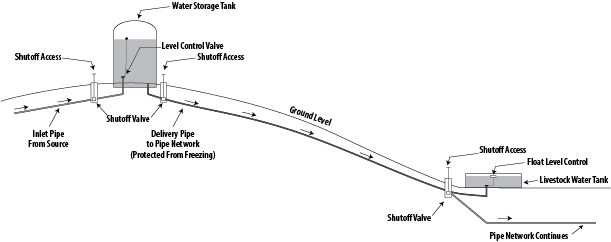 Storage tanks: Figure 1