Animal-powered Pump
Overview
Animal-activated pumping systems require livestock to learn to activate the pump; through their efforts, they can fill a drinking bowl or trough with water from a pond, stream, or shallow well. Pumps are generally activated by head action (nose pumps) or foot action. While simple and inexpensive, animal-activated pumps are best adapted for moving water short distances, about 20 feet vertically or 200 feet horizontally. One unit can supply water for a 25-cow herd. A draining bowl is needed in freezing conditions.
Advantages
- Simple, rugged, and portable.
- Livestock pump the water, no outside power source needed.
- Suitable for pond, stream, and shallow well water sources.
- Inexpensive.
- Livestock quickly learn how to activate the pump.
Limitations
- Small calves cannot operate the pump.
- Limited to moving water about 20 feet vertically or 200 feet horizontally.
- Special precautions needed for winter use.
Design Considerations
Nose pumps consist of a diaphragm or cylinder (piston) pump with a paddle that is repeatedly pushed by the animal. Water enters the pump through a hose with a foot valve that is placed in the water source.
Each push delivers about one pint of water. The pump action is relatively slow and only one animal can drink water at a time, limiting the number of livestock that can be watered in a timely way.
Nose pumps are portable and must be pinned to a solid base to avoid shifting during use. Nose pumps can create about 20 feet of vertical lift or 200 feet of horizontal draw or an equivalent combination of lift and draw. The lower the head and the shorter the distance the water must be moved, the more easily the paddle is activated.
Foot pumps operate using the same principles but generally take longer for animals to learn how to use.
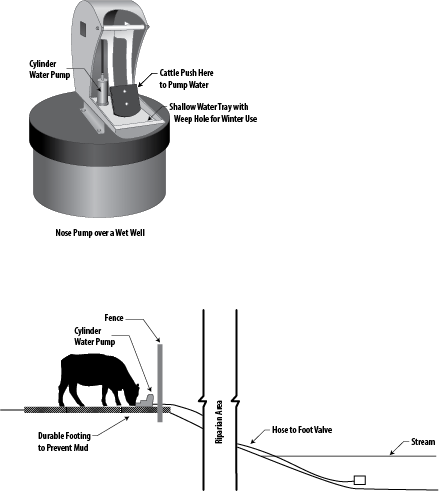 Animal-powered systems: Figure 1